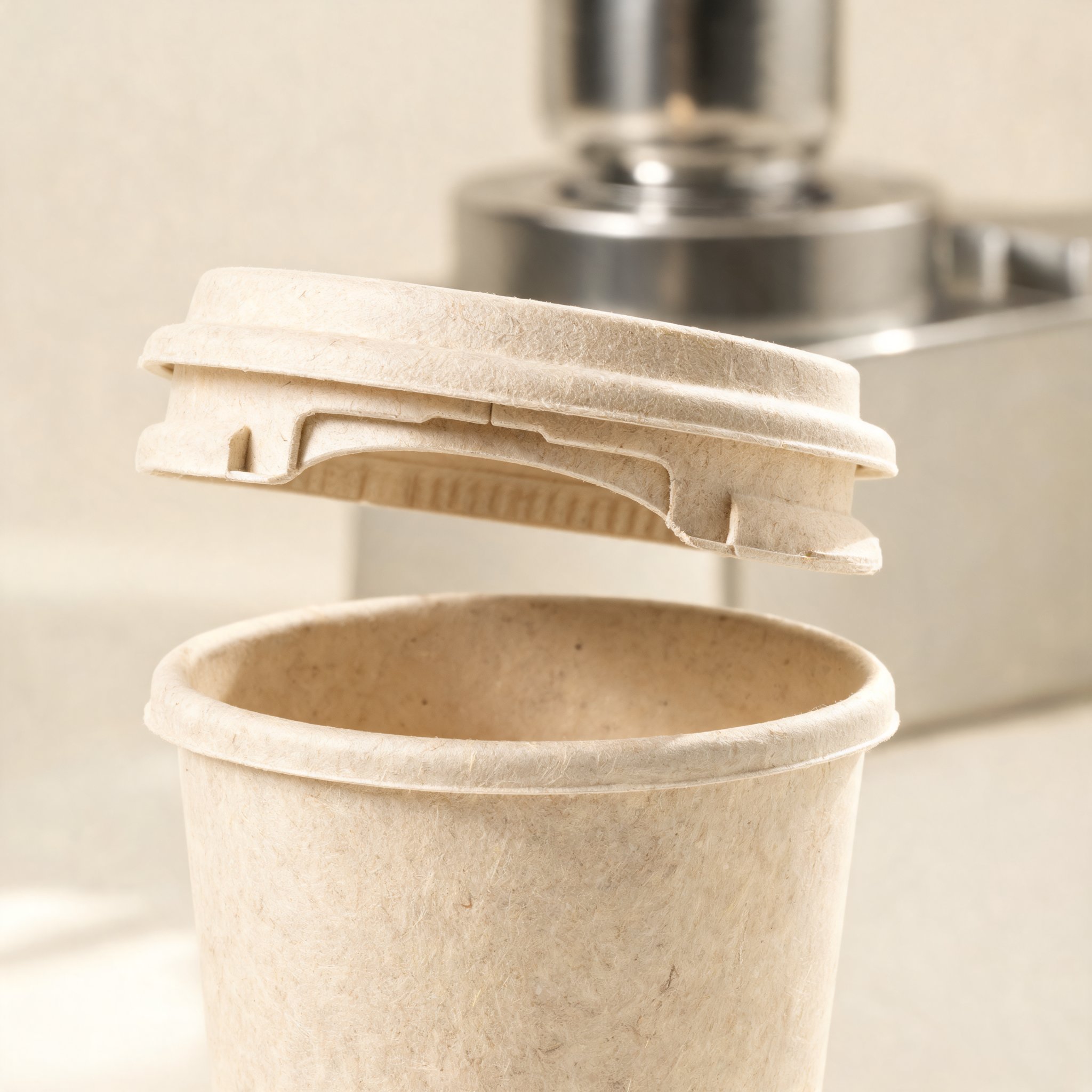
Yangi has added an undercut feature to its dry-forming platform for moulded fibre packaging, a move aimed at helping customers adopt fibre-based alternatives to components such as coffee lids.
Undercut geometries are common in plastic packaging because they enable reliable mechanical fits for snap-on lids and secure closures. Replicating those shapes in moulded fibre is technically demanding, however, because the material must hold precise geometry while remaining consistent enough for repeated use.
Yangi says its precision-engineered undercut delivers a measured lid removal force of 6 N. In testing, the coffee lid underwent 10 simulated coffee pours over 10 minutes and maintained a leak-tight seal and structural integrity when exposed to hot beverages at 93°C.
Applications beyond coffee lids
The undercut technology is also positioned for fitted closures in snack containers, takeaway containers, dessert and ice cream tubs, confectionery packaging, dry and ambient food containers, and packaging for personal care products, cosmetics and consumer goods.
Carlo Semeraro, head of Commercial Partnerships at Yangi, said precise dry-moulded fibre geometry depends on advanced tooling and forming know-how. According to Semeraro, the coffee lid shows the performance Yangi can deliver now, while the bigger opportunity is to apply the same functionality across a broader set of packaging applications.
Cellera is a dry-forming platform powered by Yangi’s patented fibre formation system, FiberIQ. Unlike conventional wet moulding, Cellera forms fibre without a water-based forming step. Yangi expects this to reduce water and energy requirements in the production of renewable, fibre-based packaging.
In the coffee lid application, Cellera’s four-second production cycle is estimated to reach an output of 300 lids per minute. The platform is designed for high-volume, cost-competitive manufacturing, combining precise fibre distribution with advanced forming technology to support consistent quality and functional performance.
Scale-up and industry context
Yangi CEO Johann Kaiser said the task is not merely to substitute fibre for plastic but to ensure fibre meets the performance level the market expects. According to Kaiser, each new capability strengthens fibre’s case as a competitive alternative by providing the functionality, quality and industrial performance needed for the transition to fibre-based packaging.
The company will display the undercut feature alongside other contributions to its dry-moulded fibre packaging range at the Sustainable Packaging Summit in Utrecht from 10 to 12 November 2026. Attendees can visit Stand 28 in the Networking Zone to view Cellera dry-forming technology through an immersive VR experience.
The announcement follows Yangi’s commissioning of its serial Cellera machine platform. Combining Cellera with the dry-forming process is expected to reduce resource consumption and CO2 emissions by 70% to 80% compared with conventional plastic alternatives, according to the company.
Separately, PulPac licensee Hébert Group has partnered with Andritz to scale up production of Dry Molded Fiber trays and lids. The partners are targeting water- and energy-efficient manufacturing that uses renewable or recycled fibres.