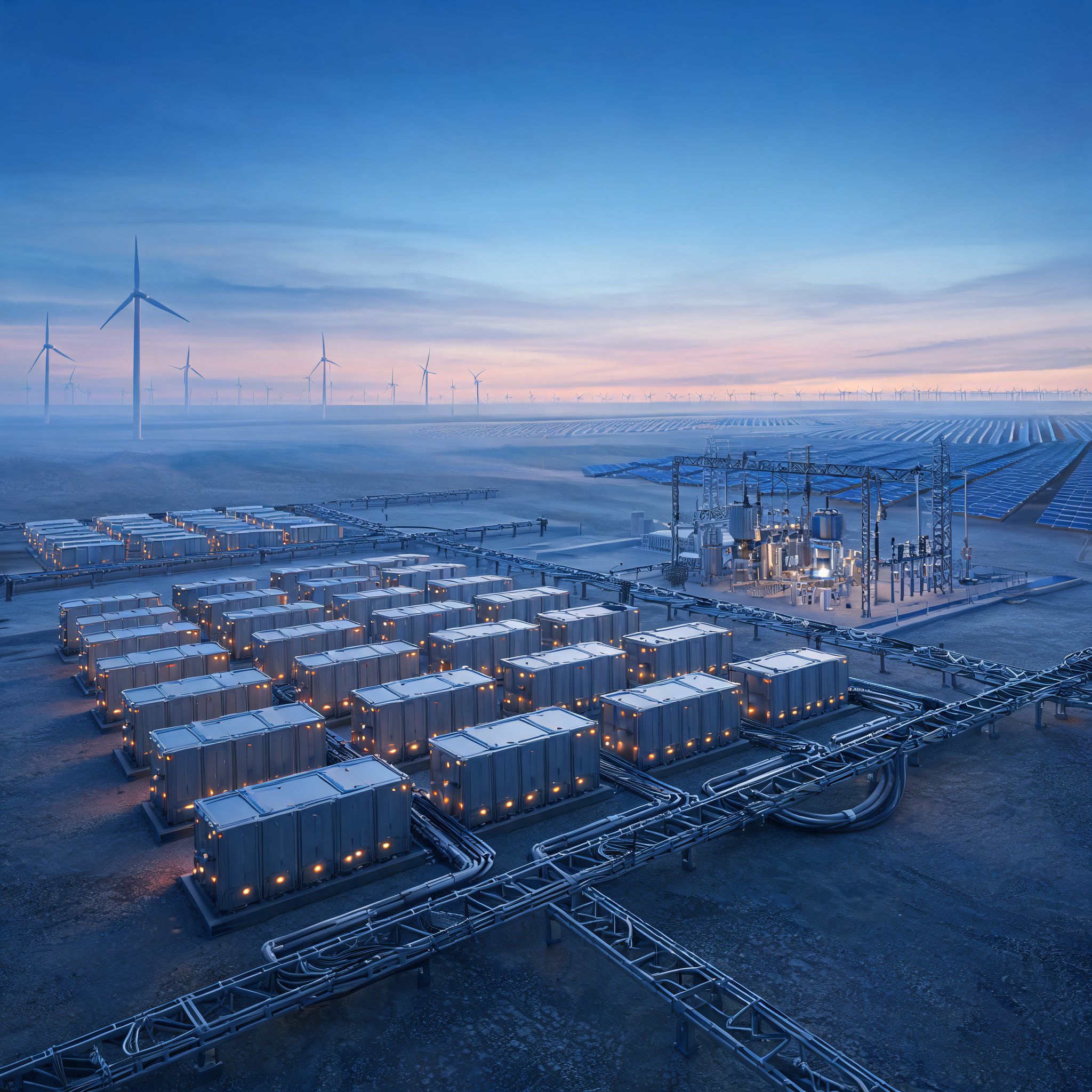
China’s operational new-type energy storage capacity reached 167 GW/435 GWh at the end of September 2026, up 63% year on year, according to National Energy Administration figures. The category covers electrochemical, compressed-air and other emerging storage systems, but excludes conventional pumped hydro. Against 135.93 GW/351.12 GWh at the end of 2025, the latest total implies a net addition of about 31 GW/84 GWh in the first nine months of 2026.
Scale gains outpace modest utilization gains
The headline number confirms that China’s storage build-out remains rapid. The 63% year-on-year increase is measured from a large and expanding base, while the roughly 23% rise since the end of 2025 shows that additions continued through the first three quarters. The more important signal, however, is not only how much capacity has been installed but how the fleet is configured and used.
Average storage duration rose to 2.61 hours, about 0.27 hours more than a year earlier. Equivalent utilization hours reached around 915 hours over the nine-month period, an increase of approximately 10 hours compared with the same period of 2025. Both changes are positive, but they are incremental. A fleet average of 2.61 hours remains below the four-hour-or-longer segment that accounted for 27.6% of 2025 installations, and a 10-hour gain in equivalent utilization is small relative to the scale of new capacity entering service.
Those figures suggest that China’s storage expansion is being accompanied by gradual changes in system configuration and utilization, rather than by installed capacity alone. They do not prove that every new project is being dispatched more intensively. The reported figures are fleet-wide, so they cannot separate newly commissioned capacity from older assets or show whether individual projects are charging and discharging more often. The NEA data therefore describe a broad trend, not a project-level performance verdict.
Renewable build-out creates the flexibility requirement
The demand-side rationale is straightforward. China’s combined wind and solar generating capacity exceeded 2.01 TW at the end of September, accounting for approximately 48.7% of total installed power capacity. That is a capacity share, not a generation share, but it still indicates the scale of variable resources that grids must accommodate. As wind and solar output fluctuates, storage is needed to absorb surplus electricity, shift generation to higher-demand periods and provide fast-response grid services.
This helps explain why storage policy has moved beyond treating batteries as an add-on to individual renewable projects. The fleet is increasingly expected to perform system-level functions: smoothing renewable output, supplying peak capacity and responding to grid events. The utilization data matter because they show whether those functions are being exercised. The modest improvement suggests progress, but also room for better dispatch and market incentives.
Market structure is shifting toward independent and larger projects
Official figures for 2025 showed that independent energy storage facilities accounted for 51.2% of cumulative new-type storage installations. Projects rated at 100 MW or above represented 72% of installed capacity, while systems with durations of at least four hours accounted for 27.6%. Lithium-ion batteries remained dominant, representing approximately 96% of installed new-type storage capacity, although compressed-air, flow batteries and other technologies are gradually expanding their presence.
These shares point to a market that is consolidating around larger, grid-connected assets rather than only smaller installations. Independent storage is also central to China’s effort to move away from mandatory storage requirements attached to renewable projects. Market reforms are intended to let independent storage operators earn revenue from electricity trading, ancillary services and capacity remuneration. If those revenue streams are available, storage can be dispatched according to system needs rather than only to satisfy a project-level obligation.
The transition is not automatic. Revenue stacking depends on how markets are designed and how dispatch is organized. The aggregate figures do not show whether independent projects are earning adequate returns or whether shorter-duration systems are being used primarily for particular services. They do show, however, that the ownership and project structure is changing alongside the physical build-out.
The 2030 target shifts attention to duration and grid support
Under the 15th Five-Year Plan for power system development, new-type energy storage capacity is targeted to reach 300 GW by 2030, with greater emphasis on longer-duration systems, grid-forming capabilities and improved operational efficiency. From the end-September 2026 base, that would leave roughly 133 GW to add over about four years. The target is therefore not only a volume goal; it also signals a change in the kind of storage that policymakers want.
Longer duration matters because lithium-ion systems dominate the fleet and many installations are still measured in hours rather than days. Grid-forming capability points to a role beyond energy shifting: supporting grid stability as inverter-based resources take a larger share. Operational efficiency matters because a larger fleet with weak utilization would add cost without delivering equivalent system value. The target’s emphasis on these qualities is consistent with the modest but positive utilization trend in the NEA data.
Regional evidence shows short-term balancing value
The growing contribution of storage is already visible in renewable-rich regional grids. In western Inner Mongolia, the grid operator reported 20.23 GW/70.47 GWh of operational storage capacity in October. During emergency dispatch operations, storage supplied up to 12.25 GW, equivalent to 33% of the grid’s electricity demand at the time. That is a striking example of how storage can provide substantial short-term balancing capacity in a system with high renewable penetration.
The example also sets a boundary. A single emergency dispatch event does not show that storage can replace firm generation or meet all balancing needs over long periods. It shows that a large, centrally dispatched storage fleet can be called on quickly when the grid is stressed. The value depends on how much energy is available, how the fleet is operated and whether market or dispatch rules allow the capacity to be used.
What the Chinese experience implies
For other countries expanding wind and solar generation, China’s deployment offers experience in large-scale storage manufacturing, grid integration and centralized dispatch. Those are relevant capabilities, but they are not a ready-made blueprint. China’s scale, supply chains and policy system shape its cost structure and deployment speed. Markets with different rules for ancillary services, capacity remuneration and renewable obligations may see different configurations and utilization patterns.
The most defensible conclusion from the latest data is that China’s storage fleet is still growing quickly, while utilization and duration are improving gradually. The 167 GW total is large, but the composition of the fleet—2.61 hours average duration, 96% lithium-ion and only 27.6% at four hours or more in 2025—shows that the next phase is as much about performance and market design as about adding megawatts. The 300 GW target and the Inner Mongolia dispatch example both point in that direction, even if the aggregate data cannot yet prove how far the transition has progressed.